US$0.00
0

Category: SOLIDWORKS

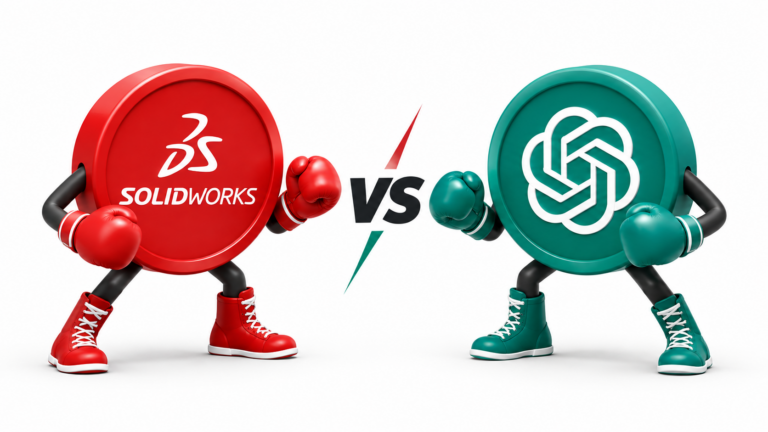
The Ultimate Showdown Between SOLIDWORKS AI and ChatGPT for Engineering

When PLM Group shared a video showing SOLIDWORKS AI generating VBA code, it grabbed my attention. Additionally, I was intrigued by the native automation and looked into the comments. I wanted to know exactly how many tokens the macro costs to generate. The answer got me thinking about the true price of engineering AI. Dassault Systèmes charges $1,250 annually for 25,000 “Blue Tokens”, making each token worth $0.05. SOLIDWORKS AI pricing mirrors a token-based model that affects project costs. PLM Group confirmed to me that generating a native macro consumes about 5 tokens. Now, we need to take this with a grain of salt because not all macros are the same in complexity. For the sake of this analysis, we’re assuming this is the average cost per macro (or unit of work as Dassault likes to call them). This brings the direct cost to $0.25 per script. A $20 monthly subscription for ChatGPT or Claude makes generations feel free. Engineers are quick to push back on token-based fees. I’ve seen this reaction firsthand from a friend who is a PDM administrator when we discussed the cost of SOLIDWORKS’ AI. But I realized that logic completely ignores the hidden cost of engineering labor. Using external AI like ChatGPT requires copying code, running VBA scripts, hitting object model errors, and pasting stack traces back into a browser. If my standard engineering rate is $90 an hour (that’s not the Blue Byte Systems’ rate by the way), spending 15 minutes context switching and debugging costs $22.50 in wasted labor per macro. With native SOLIDWORKS AI, the agent acts directly on active models and tests its own execution. I would only spend perhaps two minutes prompting and reviewing. At five tokens, the total transaction costs just $3.25. Saving 13 minutes of high value engineering time means a $1,250 token package pays for itself after just 55 macros. Yet I see a glaring flaw in the current delivery model. By locking Blue Tokens behind a $1,250 yearly subscription, the pricing structure effectively shuts out hobbyists, freelancers, and small shops. Some teams cannot always justify heavy upfront cash commitments when project workloads fluctuate wildly. Forcing users into enterprise volume packs pushes smaller creators toward external LLMs and fragmented workflows. The native AI delivers exceptional ROI for corporate engineering teams. However, to win over the broader maker and small business community, the platform could offer a flexible monthly tier. Additionally, a pay as you go token pool could work. This approach would increase accessibility. Did you know? Our product PDMShell features native Claude integration using MCP servers, bringing AI directly into SOLIDWORKS PDM and engineering data workflows. Read: Using Claude with SOLIDWORKS PDM through the PDMShell MCP Server → We can also tailor Claude-powered features to your SOLIDWORKS PDM environment and engineering workflows. Need custom CAD programming, macros, or bespoke AI integrations for your engineering stack? Contact Blue Byte Systems →

Read More »

How to Enable Ultimate Dark Mode in SOLIDWORKS PDM

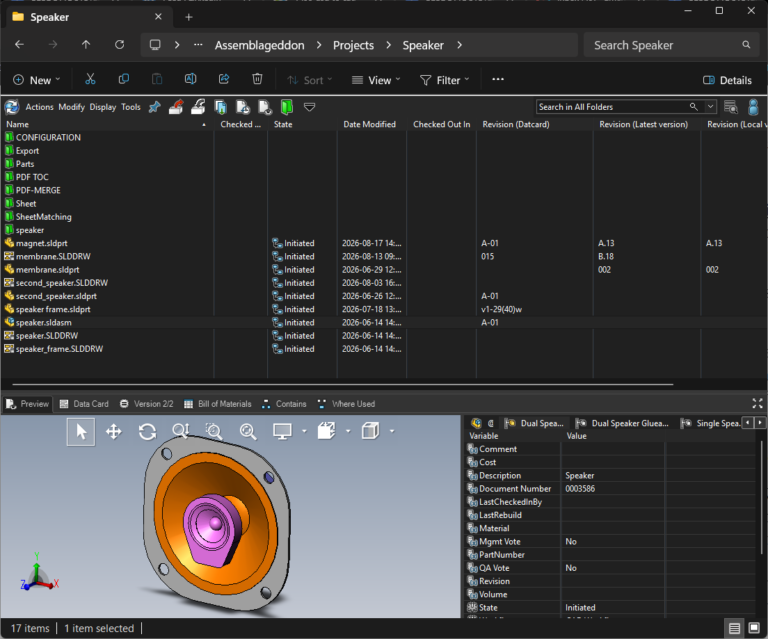
SOLIDWORKS PDM dark mode in Windows I wanted to determine if SOLIDWORKS PDM could follow Windows dark mode, including the PDM interface embedded inside Windows File Explorer. This inquiry led me to assess the available APIs and the feasibility across the Explorer integration. After a substantial amount of Windows API code, it turns out that SOLIDWORKS PDM dark mode is achievable, and this finding supports a seamless, native look for the PDM workspace within Windows. The success demonstrates compatibility with Windows themes, icons, and panel layouts without altering core functionality. Dark Mode Inside the PDM Vault SOLIDWORKS PDM runs directly inside Windows File Explorer. Adding solidworks pdm dark mode isn’t as simple as changing a few colors. The interface blends Windows Explorer with SOLIDWORKS PDM components and required work with the Windows API. The result is a plug-in that enables SOLIDWORKS PDM dark mode in SOLIDWORKS PDM 2024 and newer. Moreover, it changes the appearance of the PDM interface inside File Explorer while keeping the normal PDM functionality and workflow. Over 150 Votes for Dark Mode It looks like we’re not the only ones interested in this. Additionally, there are already SOLIDWORKS PDM dark mode enhancement requests with more than 150 votes combined. There are 147 votes for this item: https://r1132100503382-eu1-3dswym.3dexperience.3ds.com/?content=swym:prd:R1132100503382:idea:g_QlGNZKRNqQjSdPF2kQnA solidworks pdm dark mode. 20 votes: https://r1132100503382-eu1-3dswym.3dexperience.3ds.com/?content=swym:prd:R1132100503382:idea:zeCOyvCLSgugTJmUZzi26g solidworks pdm dark mode. ConisioDark This isn’t a separate PDM interface or replacement for File Explorer. The plug-in, called ConisioDark, works with the SOLIDWORKS PDM interface inside File Explorer to deliver SOLIDWORKS PDM dark mode. Since PDM lacks an API for theme changes, we used the Windows API to modify the interface. Want to Try It? If you’re using SOLIDWORKS PDM 2024 or newer, you may prefer SOLIDWORKS PDM dark mode, send us a message.

Read More »

Why Serial Numbers and Folder Number Ranges Keep Your SOLIDWORKS PDM Vault Fast

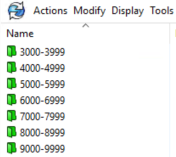
Every PDM administrator eventually runs into the same argument. One camp says the vault is a database, so folders are irrelevant and you should just search for what you need. The other camp says folders matter, because the day the “LIBRARY” folder takes forty seconds to open, everybody notices. Both camps are right, and the resolution is not a compromise between them. It is a naming convention. The debate, as it actually plays out A thread on the MyCAD forum captures this perfectly. A user asked whether SOLIDWORKS PDM should use a minimalist structure with one big library folder, or many categorized folders. His reasoning was sound: search by number and by data card variables should find the file, so why maintain a tree at all? The problem was that his company had already tried it. They started with a single LIBRARY folder and split it into Assembly, Parts, Plans and Others precisely because “the loading when opening the LIBRARY folder was long.” Other users in the thread confirmed the pattern from their own vaults, with one noting that PDM “starts to have slowness and stability from 3000” files in a folder. Treat that figure as a field observation rather than a published limit. It still lines up with what most administrators see. Somewhere in the low thousands of files per folder, browsing stops feeling instant. The most interesting suggestion in the thread came from a user who proposed keeping a minimal tree indexed by numerical ranges, since every file in his vault already carried an 8-digit auto-generated number. That single idea is the subject of this article. Why folders still cost you something SOLIDWORKS PDM is a database-backed system, so it is tempting to assume the folder structure is cosmetic. It isn’t, because folders are what the client enumerates. When a user expands a folder in the local view, the client has to reconcile every child item in that folder: name, current version, local version, state, checked-out-by, locked status, plus whatever data card columns the administrator chose to display. That reconciliation happens over the network against the archive server and the SQL database, and it happens for every item in the folder, not just the one the user wants. Put ten thousand parts in one folder and you have created a request that is ten thousand items wide, triggered every time somebody clicks the folder. Add a cold cache, a remote site over a WAN, or a replicated archive, and the cost multiplies. Meanwhile the SQL side pays for it too. Folder-scoped queries, permission evaluation, and column population all scale with the number of children. Search, by contrast, is indexed and cheap. That is exactly why the “just search for it” camp has a point. It is also exactly why it doesn’t save you. Users still browse. New engineers browse, subcontractors browse, and everyone browses when they don’t know the number yet. Why category folders are the wrong fix Splitting LIBRARY into Parts, Assemblies and Drawings helps for about a year. Then the Parts folder is the new LIBRARY. Category-based structures have three structural weaknesses. They don’t bound growth. A category folder grows without limit. Nothing in the scheme tells you when to split it, so it gets split reactively, after the slowdown rather than before. They require judgment. Is a purchased weldment a Part or an Assembly? Is a fixture a Tool or a Component? Every ambiguous case is a decision, and different people decide differently. As one forum participant pointed out, category navigation only works when metadata is properly populated in the first place, and if the metadata is that good, you didn’t need the categories. They make files move. Reclassify a component and it changes folder. Folder-based permissions, folder-based workflows and anything downstream that cached a path now have to follow it. Categories are metadata. Your vault already stores metadata, and it stores it better than a directory tree can. The fix: serial numbers plus numeric range folders The alternative is to stop treating the folder as a taxonomy and start treating it as an address. Give every file a serial number from the PDM serial number generator. Then place it in a folder determined mechanically by that number, where the first digits define the bucket. This structure earns its keep in five ways. Serial numbers beat descriptive filenames A related habit is worth breaking at the same time: filenames like BRACKET-LEFT-REV-B-FINAL.SLDPRT. Descriptive filenames encode information that changes. Revisions change, descriptions get corrected, projects get renamed, and each of those events tempts someone into renaming the file. Renames in a CAD environment are exactly as expensive as they sound. A serial number encodes nothing but identity. The description lives on the data card, where it can be edited freely. The revision lives in the workflow, where it belongs. The number stays fixed from first save to end of life. That is what makes ERP integration, supplier packages and long-term traceability work, and what makes numeric range folders possible in the first place. The half everyone forgets: your exports Here is where most well-organized vaults quietly undo their own work. The vault is disciplined. The published output is not. PDFs, DXFs and STEP files land in one flat network folder because that’s what the export task was configured to do on day one. Two years later that folder has 40,000 files in it. Unlike the vault, it has no database in front of it, no indexed search, and no client-side caching. It is a raw Windows share being browsed by the shop floor, purchasing and your suppliers, all of whom navigate by folder because that is all they have. The performance argument that justified organizing the vault applies with more force to the export target, not less. Automating it with PDMPublisher This is why PDMPublisher exposes File number range as a path variable. In the Output section of the task properties, the Export Location is assembled from tokens rather than typed as a literal path: PDMPublisher evaluates that expression per file at publish time. Part 4127 publishes to …\Released\4000-4999\, part 7318 publishes to …\Released\7000-7999\, and the folders are created as needed. The practical effect is that your published output mirrors the discipline of your vault automatically. No scripts, no

Read More »

How to Get a Free PDMPublisher Trial License

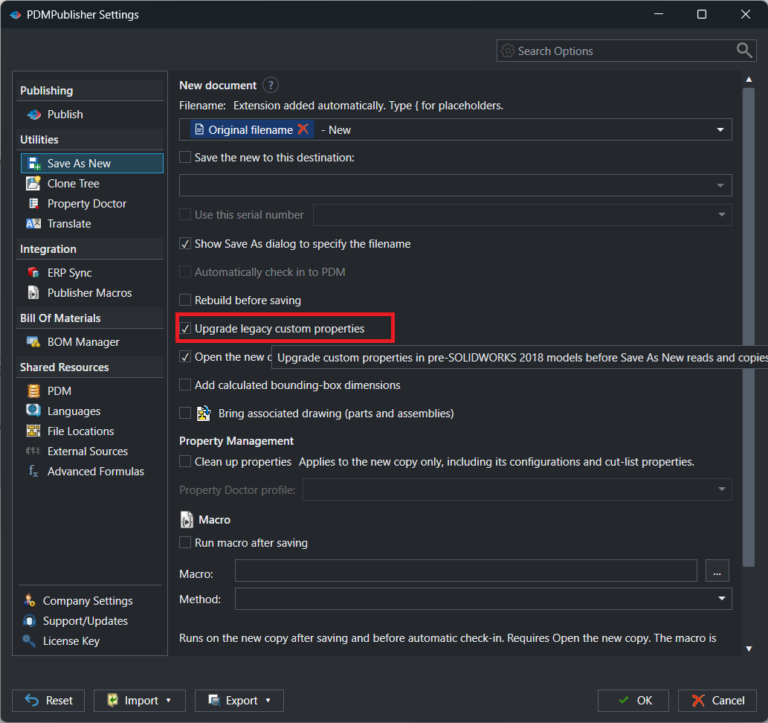
PDMPublisher helps SOLIDWORKS PDM Professional users automatically generate, export PDF, DXF. It is a great alternative to the convert task and combine documents. You can request a free PDMPublisher trial license through the Blue Byte Systems online store.This article explains how to submit your request, install the software, and activate your trial. System requirements Before requesting a trial, confirm that your environment meets these minimum requirements: PDMPublisher requires SOLIDWORKS PDM Professional and does not support SOLIDWORKS PDM Standard. Request your free trial The seat pricing displayed on the product page is provided for reference only. You will not be charged for the trial request. Important: Before submitting your order, verify that the checkout total is US$0.00 and that the selected product is PDMPublisher (Trial). What happens after submitting your request? After submitting the order, you will receive a confirmation email containing instructions for downloading, installing, and activating PDMPublisher. Your request may need to be reviewed by Blue Byte Systems before the trial license is issued. Make sure the contact and company information provided during checkout is accurate. Install and activate PDMPublisher After receiving your trial license:

Read More »

Using Claude with SOLIDWORKS PDM through the PDMShell MCP Server

Most SOLIDWORKS PDM administrators are used to working through Windows Explorer, administration tools, scripts, and custom add-ins. These tools are powerful, but even a simple question can require several steps. For example: The PDMShell MCP Server provides another way to work with this information. It connects Claude to SOLIDWORKS PDM through PDMShell, allowing users to ask questions about their vault using normal language. What is MCP? MCP stands for Model Context Protocol. It provides a standard way for an AI application such as Claude to connect to external tools and data sources. Claude does not connect directly to the PDM database. Instead, it sends a structured request to the PDMShell MCP Server. PDMShell then performs the requested operation through the SOLIDWORKS PDM environment and returns the result. The basic flow is: Claude → PDMShell MCP Server → SOLIDWORKS PDM Vault This gives Claude access to specific PDM tools without requiring the user to write a command or API application for every request. A practical example In my test vault, I asked Claude:“Can you tell me how many files are in the Unreleased PDFs folder?” Claude used the PDMShell MCP Server to inspect the folder and returned the number of files. It also identified which files were checked in and which file was checked out. I could then follow up with: “Can you undo the checkout on the file ending in R_002?” Because Claude already had the context from the first request, I did not need to enter the complete file path again. This is where the connection becomes useful. It is not only a chatbot answering general PDM questions. It can use tools provided by PDMShell to retrieve current information from the vault and, when permitted, perform an operation. Why use natural language? PDMShell already provides commands for automating common PDM operations. The MCP Server adds a conversational layer on top of those tools. Instead of remembering the exact syntax of a command, a user can describe the result they need. Claude interprets the request, selects the appropriate PDMShell tool, and presents the result in a readable format. This could be useful for: It can also help administrators explore a problem before deciding what action to take. Permissions still matter Connecting Claude to PDM should not bypass the existing security model. PDMShell operates within the permissions of the logged-in PDM user. If that user cannot access a folder or perform an operation, the MCP Server should not provide a way around that restriction. Write operations also need to be handled carefully. Reading the contents of a folder is very different from deleting a file, changing metadata, or undoing another user’s checkout. For that reason, the server should expose only the tools that are required. Important actions should also be reviewed before they are executed. This does not replace PDM administrators The goal is not to let AI make uncontrolled decisions inside a production vault. PDM administrators still define the workflows, permissions, variables, naming rules, and automation requirements. Claude provides a simpler way to interact with the tools that have been made available through PDMShell. The administrator remains in control of what Claude can access and which operations it can perform. Where this can go next The first use cases are straightforward: search the vault, inspect folders, read file information, and perform controlled file operations. The more interesting possibilities come from combining several operations. A user could ask Claude to identify files matching specific conditions, summarize the results, and prepare the next action for approval. That could make routine PDM administration faster while still keeping the vault’s permissions and business rules in place. The PDMShell MCP Server is an early step toward making SOLIDWORKS PDM easier to work with through modern AI tools. It combines the automation capabilities of PDMShell with Claude’s ability to understand normal language and maintain context throughout a conversation.

Read More »

PDMShell vs. PowerShell: The CAD Admin’s Guide to Engineering Automation

If you work in engineering IT or CAD administration, you’ve likely spent hours trying to make different software systems talk to each other. When searching for ways to automate these clunky processes, two tools with confusingly similar names always pop up: PowerShell and PDMShell. They sound like variations of the same thing, but they aren’t. One is a massive tool built by Microsoft for managing entire corporate networks. The other is a sharp, niche utility built by Blue Byte Systems specifically for SOLIDWORKS PDM Professional. Let’s break down what they actually do, how they differ, and why you might end up using both. The easiest way to understand the difference is by looking at what they were built to control. PowerShell is for your entire operating system and cloud environment. PDMShell is strictly for your SOLIDWORKS PDM vault. Feature PowerShell PDMShell What does it control? Windows, cloud servers, and networks SOLIDWORKS PDM vaults only Who made it? Microsoft Blue Byte Systems Inc. How do you use it? Advanced programming (.NET objects) Simple text scripts (.pdmshell) Who is it for? IT Admins and DevOps Engineers CAD Admins and Data Managers How do you get it? Built right into Windows Download from pdmshell.com PowerShell is Microsoft’s heavy-duty automation framework. It is incredibly powerful because it doesn’t just read plain text; it understands actual data objects. If an IT admin needs to create 50 new user accounts in Active Directory, back up a server to the cloud, or update software registry keys across an entire department, they use PowerShell. The downside? It has a steep learning curve. Because it is a full programming language tied to Microsoft’s .NET framework, you need a decent grasp of coding logic and complex syntax to get anything done. PDMShell: The SOLIDWORKS Short-Cut. If you’ve ever tried to customize SOLIDWORKS PDM, you know that interacting with its API usually requires writing complex C# or VB.NET code in Visual Studio. For a CAD manager who just wants to get a job done, this is often overkill. That is why Blue Byte Systems built PDMShell. It acts as a friendly middleman for the complex PDM API. Instead of writing lines of heavy code, you write simple text scripts using straightforward, built-in commands like checkout, checkin, or addtovault. It plugs right into your existing PDM Tasks and Dispatch actions, letting you automate boring vault tasks without needing a degree in software engineering.

Read More »
0
0
Your Cart
Your cart is emptyReturn to Shop